
november 10, 2026 // 15 min read
halo
even the lazy ones have already written a post on vibe-coding so why am i any worse?
so for the past six months or so i've been vibe-coding (or as i prefer calling it, practicing "agentic software engineering"), and when i say that - i mean like, a lot.
at some point i even added a "tokens wasted" row to my main page as a joke, and as of writing it's ~85B all time (~20B of which is just the past 30 days. that's 23% btw)
yes, most of those are cached reads (81.7B).
the actual output is "just" ~400M, but big numbers more funy
and quite a big chunk of it went into inugram, my fork* of telegram for android. i never would've started this project if not for llm-s, because the amount of time it would take me to maintain it just wouldn't be worth it. shoutout to itaysonlab & ctwoon with their catogram
and like, it's pretty good? i built it because i was tired of every other client, and now it has over 200 stars, many of my friends and oomfs use it, people even send prs, and i'm genuinely happy with how it turned out.
and well, ai wrote most of it.
sounds like it should be easy, right?
type a prompt, play some genshin or whatever, and there you have it.
except it was not. it ate a stupid amount of my life, way more than i ever anticipated.
but at what cost?
since april, based on my wakatime, inugram alone took:
- about 650 hours. that's 16 full-time work weeks, on an open-source fork.
good thing im currently unemployed (hire me btw!) - on at least 185 of the last 212 days
- totalling +320k -97k lines, whatever that's worth. sloc means nothing anymore anyway.
...and that's just one project. in total, compared to the previous year:
| apr-nov 2025 | apr-nov 2026 | |
|---|---|---|
| total | 690h | 1346h |
| manual coding | 641h | 168h |
| ai coding | 0h | 1149h |
| days >8h | 12 | 73 |
| days >12h | 1 | 17 |
| weekends | 178h | 343h |
even though the number of hours of manually typing code went down, the total number of hours spent coding almost doubled. and that's considering i was employed back then, lol.
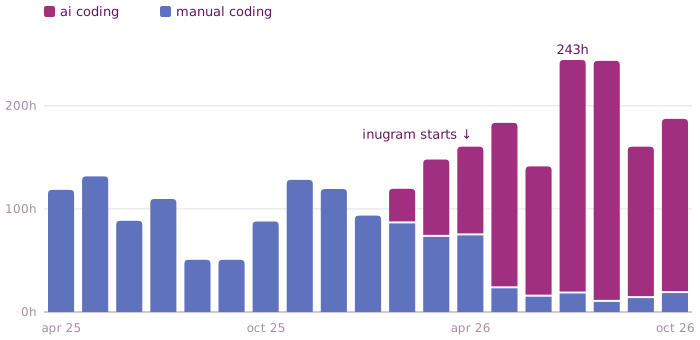
obviously, "ai coding" counts all the time the agent spends thinking, so it's not like i was staring at the screen all that time
but it's also not like i could do anything else either
where did the time go?
if ai is doing most of the work, what are those 1149 hours?
well, turns out writing software was never just about typing code (shocker, i know). everything else is still on me:
- designing the architecture, thinking about the edge-cases and requirements.
which is, like, most of what swe is and always was, lol - reading the code. models write code way faster than i can read and review it, and you can't trust them to get it right the first time just yet
- checking the thing. running it and seeing if it actually works like i want it to.
- polishing: "no, not like that". and then again. and then again, but in a new session, because this one has too much context and is dead-set on something wrong.
and in fact, since typing code is no longer a bottleneck, it means i can ship more features, which means even more of the above than usual!
tooling problem
the checking part is the worst by far, honestly. current tooling for many languages (yes, java/kotlin and rust, im looking at you) is just way too slow, and way too resource-hungry.
most modern programming language tooling is written with a human developer in mind. a human would normally just work on one or two projects at a given time, in one branch, recompiling only once in a while, with an lsp doing most of the work.
ai agents.. usually do way more than just that. an agent rebuilds and re-runs the tests after every tiny change, so ai takes seconds to write the code, and then sits there for minutes waiting for the compiler. a lot of that "ai coding" time is really just gradle and cargo doing their thing, bruh.
and it only gets worse once you have a few agents going across a few projects in parallel. each of them runs its own cargo build, possibly in multiple worktrees, and each of those assumes the entire machine is theirs.
so i would regularly look up and see 800% cpu usage, get WindowServer oom-killed (yes, really), or run out of disk space (20gib target/ * 5 projects * 5 worktrees in each. thankfully kache exists).
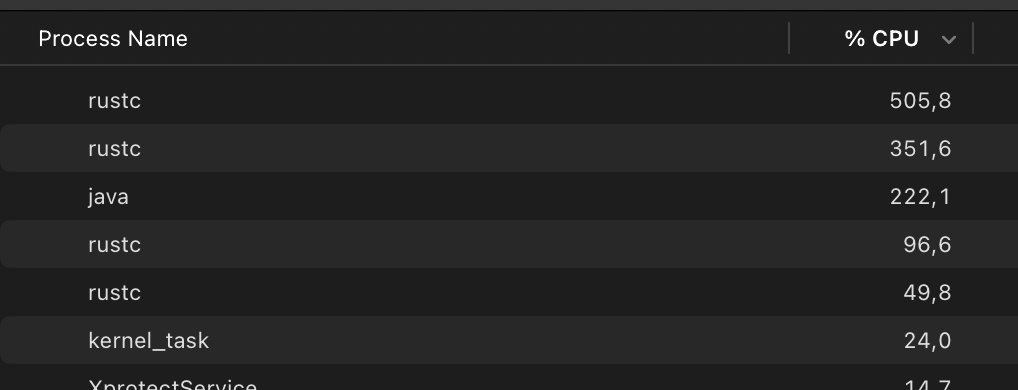

even worse, many build systems just straight up don't support parallel builds of the same project.
cargo build has a per-outdir lock, gradle doesn't even have that and silently fucks up build caches 🥴
and even when it all finally builds, the agent can't tell me whether it looks right or not. someone still has to open the app, poke at it, and hand it back to the agent because the fix didn't work. then wait, poke again, wait... you get the idea
well i mean, in many cases the agent itself can be that "someone"
as long as it doesn't need "taste" to verify it.
and at the cost of even more time and tokens spent
my job is now mostly qa (which i honestly hated for as long as i did swe) for a very fast, very smart, but at the same time very dumb monkey at the keyboard. and anyone who has ever managed people can agree that it's not an easy task.
free as in puppy
no im not free dont @ me
there's an old joke about software being "free as in puppy"
code is free now, but free as in puppy - the maintenance burden (at least the mental one) never goes away. it's with me indefinitely
inugram is a patchset on top of upstream, so every patch has to be rebased, every feature needs translations and a changelog line, and every feature also interacts with the rest of the app. and this all needs to be kept in mind.
yes, most of the above an agent can do on its own. but someone still needs to drive it, someone still has to manage prs,
someone still has to make sure the agent didn't add yet another rce, or pull a dependency with a crypto drainer.
someone still has to assume responsibility
now compare it to stuff like the pixel ruler (which in fact i made to help debug some visual bugs in inugram, lol). fully vibe-coded, one page, does one thing well enough, and solves a real problem i had. i don't have to think about it ever again, i just use it when i need to count pixels.
that code is actually free.
nothing says no anymore
this one has been discussed quite a lot in the community, so i won't reiterate much, but this thing is so real that i just couldn't not mention it.
the cost of writing code used to be a filter. i would think "it would be cool if...", then imagine spending half a week on it, and then just decide it's not worth it. it probably was in fact not worth it.
and now that filter is gone. "it would be cool if" turns into the thing in a few prompts.
> it would be cool to have palantir ice peter thiel ai data harvester 9000 stripping in inu > look inside > either hardcode a few websites and call it a day, or embed the adguard dataset > look inside > there's no ready-made parser/interpreter for those rules > mfw
obviously i went with the latter. obviously i would've just hardcoded twitter/youtube/tiktok (or dropped the feature entirely) if llm-s weren't a thing.
and that's the small stuff. inugram also has a plugin engine as of late.
in rust. with quickjs and a jni bridge and hookers, an on-device test suite, and an sdk with its own cli.
in a telegram client. that started as "i want less bloat".
well... yeah.
apparently theres a name for this - jevons paradox: make coal more efficient and people end up burning more of it.
tokens really are the new coal, and ai is the new industrial revolution.
individual changes got cheaper, but there are so many more of them that the total went ↑up↑
this one is mine (not really)
the inugram readme starts with "there are many tga forks, but this one is mine", and says that it "exists primarily for my own personal use". and that was true for a while.
but at some point it really stopped being my client that i made for me and my friends.
the more users i had, the more features i added - not because i needed them, but because someone i don't even know asked for them, and i felt bad refusing.
"that's too much work" used to be a perfectly good excuse, but now that it's one prompt away (and everybody knows it), saying no feels like being mean on purpose. so i say yes, and now a feature i will never use is yet another patch i have to maintain, in a client i'm spending my evenings on, and making a total of $0.
it doesn't even cover my claude subscription 😭. donate plz
in fact, the plugin engine was primarily a way to stop most of the "i want feature X" dms.
"just vibecode yourself a plugin", and everyone is happy.
maybe that is the future of software - providing some api for everyone to slop-customize it
how to spend the next 10 minutes?
is the question i still really have no answer to.
with manual coding, most of the "waiting" time we had was waiting for compilation/tests/ci. which was predictable. when you've worked on a project for a few months, you naturally just learn how long it takes on average, so you can decide how to spend it upfront.
i have adhd though, so even those wait times always felt like hell for me - either i just stare at the screen while scrolling tiktok (to see when it's done), or i go do something else and forget about the ci release flow running until my coworker dms me like "is X in prod yet?", and i have to somehow cover up the fact that i straight up forgot about it. bweh.
in fact, before i had a real job i never really had any of those waits - vite/webpack were always fast enough, hot reload made the changes appear instantly,
i had roughly zero tests, and my ci was a single deploy.sh script that did scp + systemd restart. oh well, simple times.
well, changes no longer appear instantly. and even the wait time is no longer predictable.
claude can either one-shot a large complicated task in a few minutes, ready for me to test, or debug a (seemingly) simple bug for hours. you literally never know.
what am i supposed to do during that time?
- play a game? too bad, the agent finished half an hour ago and i "wasted" it.
bro just one more quest and i'll get back to you. - read something? again, either i get too immersed, or i am reading the same paragraph for the third time because context switching is damn hard
- watch it work? no thanks
- start another agent? this is the one i usually do, and now i have twice as much stuff to review, and still some time to waste
it's genuinely really hard to find anything that fits in the gap without swallowing me whole. might just be adhd, who knows.
it has to be interesting enough for me to want to do it, but boring enough to drop at any moment.
and i don't think that anything good matches that, except maybe doomscrolling tiktok/twitter.
isn't this free time? the machine works while you do nothing, you lazy bum
GIRL I WISH
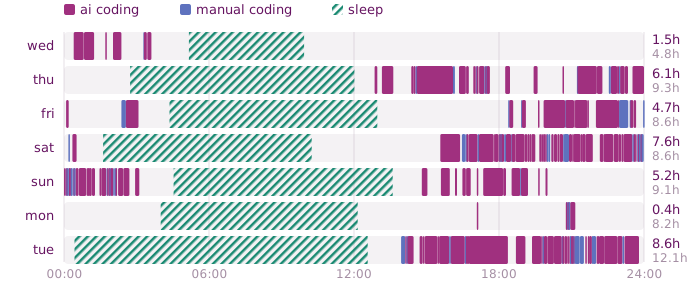
it's not rest, because i'm still on call.
and it's not really work either, because i'm not doing anything.
my day gets cut into these randomly-sized slices, and at the end of it i'm tired and can't really say from what.
context switching, probably.
the era of personal slopware
anyone can just write an app for themselves now, exactly the way they see it. me included.
my ~/Projects is full of stuff i slopped primarily for myself, most of which you will probably never see nor use. inugram is just the biggest one.
to name a few:
- my own screenshot tool
- a moonlight fork with lower latency and some other perf improvements and features
- well, technically not me and not for myself, but i contributed a bit bc i find it useful too
- a sidebery fork ported to chrome, because the maintainer didn't seem to bother adding support for years
- a window management thing that solves exactly my needs, and probably nobody else's
- a tiiiny tray app to make switching between my gaming pc and macbook a bit less annoying
- an sftp client (still wip)
- an ai agent harness (also still wip)
and more stuff like that.
and i'm rly happy with them all! most of them did solve something that annoyed me about the existing software.
but i can't really tell if they were actually worth my time.
would i work on them if i had an actual full-time job? i don't really know either.
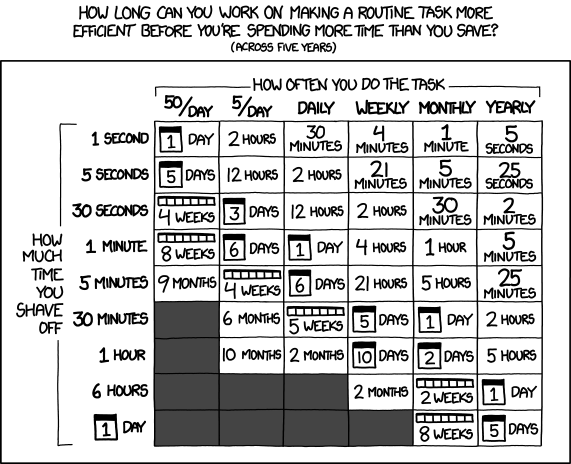
xkcd has a famous chart on how long you can spend automating something before it stops paying off.
but how do you even put "annoyance" on it?
how many minutes a day does a tool that doesn't annoy me save?
a tool that opens 100ms faster, and renders at 160fps compared to alternatives?
close to zero, probably. i just get annoyed less.
the cost side isn't any clearer. wakatime says about 10-20 hours for most of the ones i checked, except it also logged 225 "projects" since april,
some of them literally called o and do (thanks codex for awesome folder names), so i wouldn't trust that too much.
nor do i have any idea what i would've done with those hundreds of hours instead. maybe something better, maybe just more scrolling and playing chinese gacha games. im unemployed, after all.
if everyone can just write their own app, is coding dead?
"coding" as in "typing code" - yeah, kinda. everything else clearly isn't, since the total almost doubled.
personal slopware is about as close as it gets to code actually being free. if im the only user, it only has to work for me on my machine. there are no other users, thus no bugs, and when it breaks i just tell the agent to fix it.
that's how you get a whole pile of tools for a few hours each.
except it will inevitably break, and that's a few more hours. and it really does add up.
but inugram started the same way, and then it got users, and that's how you get 650 hours.
so anyone can make software for themselves now, but not many actually will. and making it for other people is still a real job.
and i'm not even sure how far you can get without years of experience writing code by hand, because designing architecture, reviewing, polishing ui/ux and knowing when to stop still depend on knowing what the end result should look like.
something like an outro
i just really did the math wrong. ai wrote me all the code, i got rewarded with some cheap dopamine, and then figured the project would cost me basically nothing even long-term.
but the code was never the expensive part. getting something actually good still takes hundreds of hours of love and care for the product. and the models just can't do that, at least not yet
so when someone says software is basically free now, i'd like to see their wakatime.
at this point, we should probably stop asking "can claude do this?" - the answer is pretty much always yes.
a much better question is "do i want to spend my evenings on this?". and in a lot of cases, the answer really is "no".
what's next?
i can only hope that models get smarter, cheaper and faster.
i hope the tooling gets better too.
i hope the gpus/npus get faster and more affordable.
i hope they find a cure for adhd
all of the above would mean less "time wasted waiting for the agent", which i think is nice. and i am really looking forward to the future where every household has a self-hosted opus 5.5.
but i know that's all just wishful thinking. and i know things right now are probably the best they are going to be in the near (5-10 years) future.
ai labs keep fearmongering us with the paperclip maximizer, and more and more people are advocating for ai regulations, safeguards, "alignment" and "pacing the frontier".
which really is dumb in my opinion. we are still very early. and all the safeguards do more harm than good.
but that's all for another post.
ok bye